
Parkinson’s disease, in English (Parkinson’s Disease), abbreviated PD, is a progressive, degenerative and long-term disorder of the central nervous system that mainly impairs the body’s motor system. The signs of this disease usually appear slowly and gradually, and as the disease progresses non-motor symptoms also emerge. The most obvious early signs of this disease are tremor, stiffness of the body, slowing of movement and difficulty in walking. The cognitive and behavioural signs of this disease also usually appear in most people in the form of depression, anxiety and a lack of interest and enthusiasm.
In the advanced stages of Parkinson’s disease, dementia is also sometimes common. A person with Parkinson’s may also experience problems with sleeping and with their sensory system. The motor signs of this disease occur because of the loss of cells in the substantia nigra of the brain and the resulting decrease in dopamine, which is a neurotransmitter. Dopamine is of great importance for maintaining the body’s normal movement patterns, and it is precisely for this reason that many Parkinson’s treatments are carried out with the aim of increasing the level of dopamine in the brain.
In Parkinson’s disease, the loss of neurons (nerve cells) also occurs in other parts of the brain and paves the way for some of the non-motor symptoms of this disease. In addition to the decrease in dopamine and in the cells that make dopamine, a protein called alpha-synuclein also has a role in Parkinson’s disease. Under normal conditions alpha-synuclein helps neurons to communicate with one another, but in Parkinson’s disease this protein gathers in microscopic clumps called Lewy bodies. Researchers believe that alpha-synuclein has a role in the progression of Parkinson’s and that it may be possible to develop new treatments that prevent this protein from accumulating.
Although the cause of Parkinson’s disease is not entirely clear, we know that both genetic and environmental factors have a role in its occurrence.
Among these, factors such as increasing age, a family history of Parkinson’s disease, genetic mutations, sex, exposure to pesticide toxins, the use of certain medicines and a history of brain injury and trauma can be mentioned as factors in the occurrence of this disease. Users of tobacco, coffee and tea have a lower risk of developing Parkinson’s.
Classification of Parkinson s disease
Parkinson’s disease is the most common type of parkinsonism and is sometimes called idiopathic parkinsonism, which means parkinsonism with no known cause. Scientists sometimes regard Parkinson’s as a type of neurodegenerative disease called a synucleinopathy, which arises from the abnormal accumulation of the protein alpha-synuclein in the brain. Classifying Parkinson’s as a synucleinopathy distinguishes this disease from other neurodegenerative diseases such as Alzheimer’s, because in Alzheimer’s another type of protein, called tau protein, accumulates in the brain.
Between the diseases of the tauopathy and synucleinopathy classes there are significant clinical and pathological overlaps, but differences are also apparent. Sufferers from Alzheimer’s disease, unlike people with Parkinson’s, often experience loss of memory. The main and fundamental signs of Parkinson’s, namely slowness of movement, tremor, stiffness and instability of posture, are usually not among the signs of Alzheimer’s.
So far efforts have been made to classify Parkinson’s into other subcategories, especially with a focus on the age of onset of the disease, the progression of symptoms and increasing tremor, but none of these classifications has been definitively accepted.
Signs and symptoms of Parkinson s
The best known symptoms of Parkinson’s are the motor symptoms. Non-motor symptoms, including dysfunction of the autonomic nervous system, neuropsychiatric problems, changes in mood, cognitive abilities, behaviour or thought, sensory problems especially changes in the sense of smell, and problems related to sleep, are also common in people with this disease. Some of these non-motor symptoms may already be present at the time the disease is diagnosed.
Motor symptoms
Parkinson’s is identified on the basis of four main signs of the disease; trembling and shaking of the hands and feet at rest (tremor), slowness of movement (Akinesia), hardness and stiffness of the hands, feet and body (Regidity) and a mask-like face
(Flatface) are the four main signs of Parkinson’s.
In the early stages of the disease, trembling of a limb is mild and usually present on one side of the body, and there is no need for treatment; but as the disease progresses the person is no longer able to control the severe trembling of their limb, especially when they want to concentrate more.
If two or more of these signs are seen in the patient, especially when they appear on one side of the body more than on the other, a diagnosis of Parkinson’s is made, unless other concurrent signs are present that reveal another disease. At first the patient may sense the disease through trembling of the hands and feet or through weakening of movement, and find that doing anything takes longer than usual, or may experience hardness and stiffness of movement in the hands and poor balance. The first signs of Parkinson’s are a varying combination of tremor, bradykinesia, muscle rigidity and poor balance.
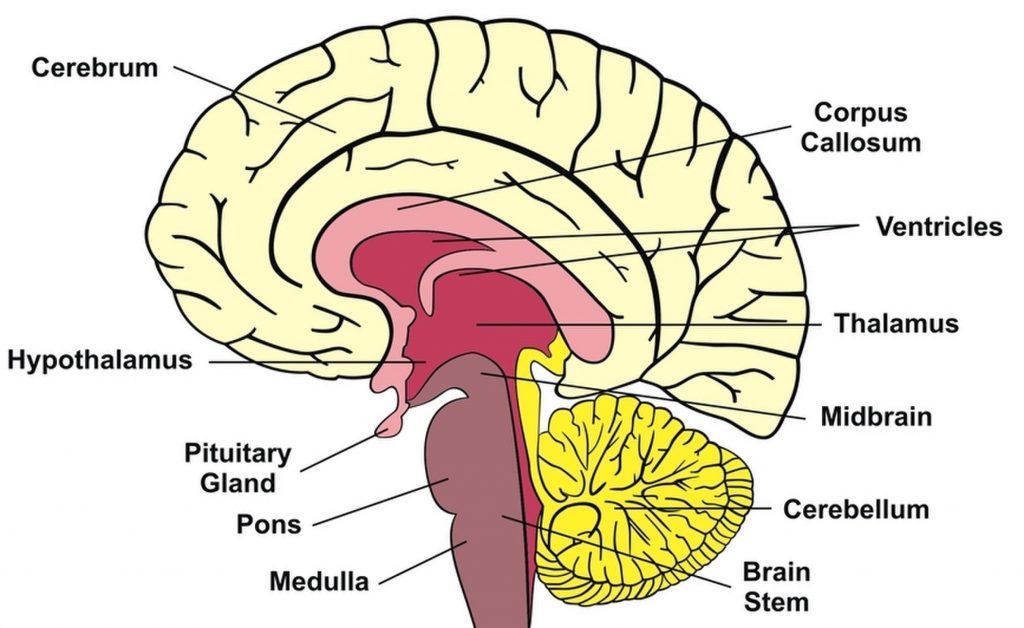
An image of the dopamine pathways in the brain
Changes also occur in the expression of the face and countenance, including fixation of the facial expression (apparently few emotions are shown on the face) or a staring look (because of reduced blinking). In addition to these, stiffening of the shoulder or limping of the leg on the affected side are among the other complications of this disease. Older people may attribute the appearance, one by one, of these signs of Parkinson’s to increasing age, may take the tremor for a shake, may attribute bradykinesia to normal slowing down and muscle stiffness to arthritis. Many of these people also attribute the stooped posture of this disease to age or to osteoporosis. Both older and younger patients may go to a doctor for diagnosis only after more than a year of facing these complications.
Neuropsychiatric symptoms
Parkinson’s can lead to neuropsychiatric problems ranging from mild to severe, including mood, cognitive, behavioural and thought disorders. Cognitive disorders may appear in the early stages of the disease, sometimes before diagnosis, and may become more severe during the course of the illness. The most common cognitive deficit in Parkinson’s is impairment of executive functions, which can include difficulty with planning, cognitive flexibility, abstract thinking, impulse control, working memory and attention control. Other cognitive problems in Parkinson’s are reduced speed of cognitive processing, impairment in memory retrieval, and impairment in perception and estimation of time. Of course, retrieval of information usually improves when the person is given a cue. Impairment of visual-spatial perception is also part of this disease and is seen, for example, when recognizing a face or understanding the orientation of lines.
A person with Parkinson’s has a two- to six-fold higher risk of developing dementia than other people. Up to 78 percent of people with Parkinson’s develop dementia related to this disease. The prevalence of dementia increases with age and, to a lesser extent, as more time passes from the onset of the disease. Dementia leads to a reduced quality of life for the patient and their caregivers, increased mortality and an increased likelihood of needing to be admitted to a nursing home.
About this article
To report a content error, contact Bagh Omid and let us know. Editorial policy & sources